

What parents need to know about what their kids are exposed to online
Over the past several months, I’ve been following different stories related to online safety for kids, particularly teenage girls. As a result, my LinkedIn feed has adjusted my algorithm to include posts from people who are reporting on a wide variety of risks from bullying to glorifying eating disorders.
Though somewhat ironic, I asked Anthropic’s Claude (a generative AI tool) to crawl the well in order to cull together any stories about the risks of social media for teenagers. The results are alarming.
I want to emphasize a growing threat that every parent needs to be aware of. According to the FBI, an extremely dangerous yet influential group dubbed network 764 is leveraging social media to, “coerce and manipulate minor victims into harming themselves, animals, and other minors.”
Research, incidents, legal actions, and policy responses
A research summary across platforms looked at issues related to mental health, sexual exploitation, algorithmic harms, and legal accountability. The results show:
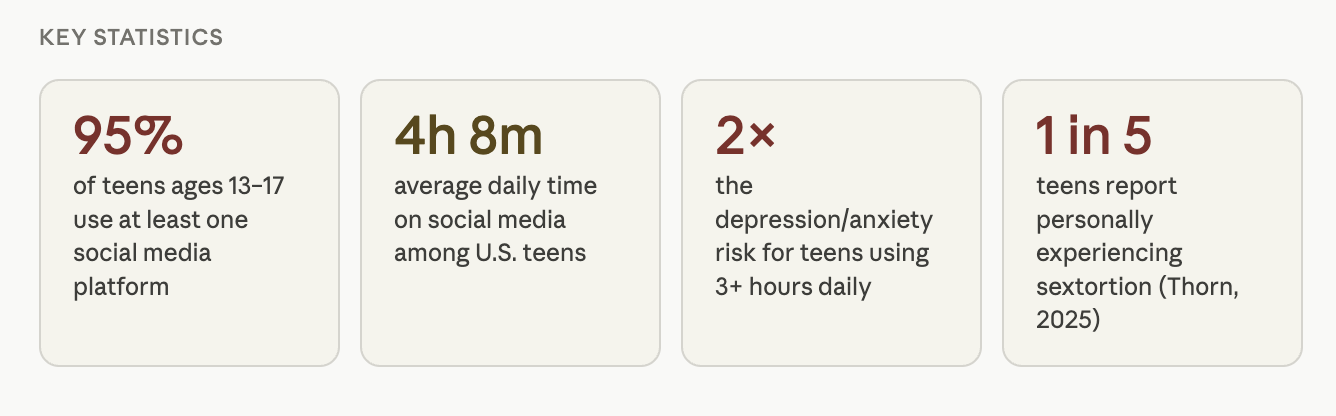
A few additional things that stand out from the first few months of 2026:
-
The legal tide is turning. A California jury found Meta and Google negligent, awarding $6 million ($3M compensatory plus $3M punitive) with Meta on the hook for 70% of that sum. For those who don’t know, CNN reported on the Meta verdict that will hopefully bring about change to social media platforms. As I have written about before, the trial alleged Meta disregarded its own internal research proving the platform is harmful to kids, lawyers referenced unsealed internal documents quoting Meta researchers as saying, “IG is a drug… we’re basically pushers.” Additionally, internal Snapchat documents cited infinite scroll and autoplay as “unhealthy gaming mechanics” while noting users “feel obligated” to maintain streaks, which “become stressful.”
-
The deepfake crisis is escalating dramatically. In the first six months of 2025, the National Center for Missing and Exploited Children (NCMEC) received 440,000 reports of AI-generated child sexual abuse materials (CSAM). Just last month, WIRED and Indicator reported on the crisis of deepfake sexual abuse incidents that has impacted approximately 90 schools across 28 countries with more than 600 victims worldwide.
-
Australia’s social media ban for those under 16 revealed both the severity of the problem and the limits of legislative fixes. A survey found more than 60% of teens who had accounts before the ban still had access to at least one platform. Savvy users turned to VPNs, parents’ face IDs, and AI-generated adult faces to evade detection.
Additional legislative action is pending, including, the James T. Woods Act, a three-bill package named for a high school student who died by suicide after being sextorted. Introduced by Senate Judiciary Chairman Chuck Grassley and Ranking Member Dick Durbin, the package has bipartisan support and includes the following three bills.
-
SAFE Act: a directive to update outdated CSAM sentencing guidelines to reflect modern technology.
-
ECCHO Act: specifically targeting networks like 764, this bill intends to create a new federal crime specifically prohibiting online coercion of children to harm themselves, others, or animals. Penalties up to life in prison if the offense results in a death or suicide.
-
Stop Sextortion Act: raises the maximum penalty for threatening to distribute CSAM from 5 to 10 years. The bill has received committee endorsements from the FBI Agents Association, RAINN, Thorn, Snap Inc., and the National District Attorneys Association ahead of a Judiciary Committee vote.
What Parents Can Do
Not surprisingly, the landmark trial against Meta and Google has had a sort of Paul Revere effect for social media platforms. Angry parents are coming after them, and thousands of lawsuits are in the works.
There are plenty of activists out there who are doing the work of fighting for the platform changes that will help to protect kids.
As special agent Mason said, the FBI does “need your help in rooting out these criminals.” While it might feel scary to think about calling the FBI, the are actually just people who are trying to do their job, and their job is to protect innocent victims. I’ve had the great fortune of working with several different agents, and they are incredible human beings. So, I echo the words of special agent Mason: “If you or someone you know is a victim or if you have information about the activities of a violent online network, we encourage you to call 1-800-CALL-FBI.”
I’ll close by quoting a line from one of my favorite Arthur Miller plays, All My Sons. Ann asks her son Chris, “what more can we do?” to which her son responds, “you can be better.” I was moved by that response the first time I read the play 25 years ago, and it has stayed with me for more than two decades.